
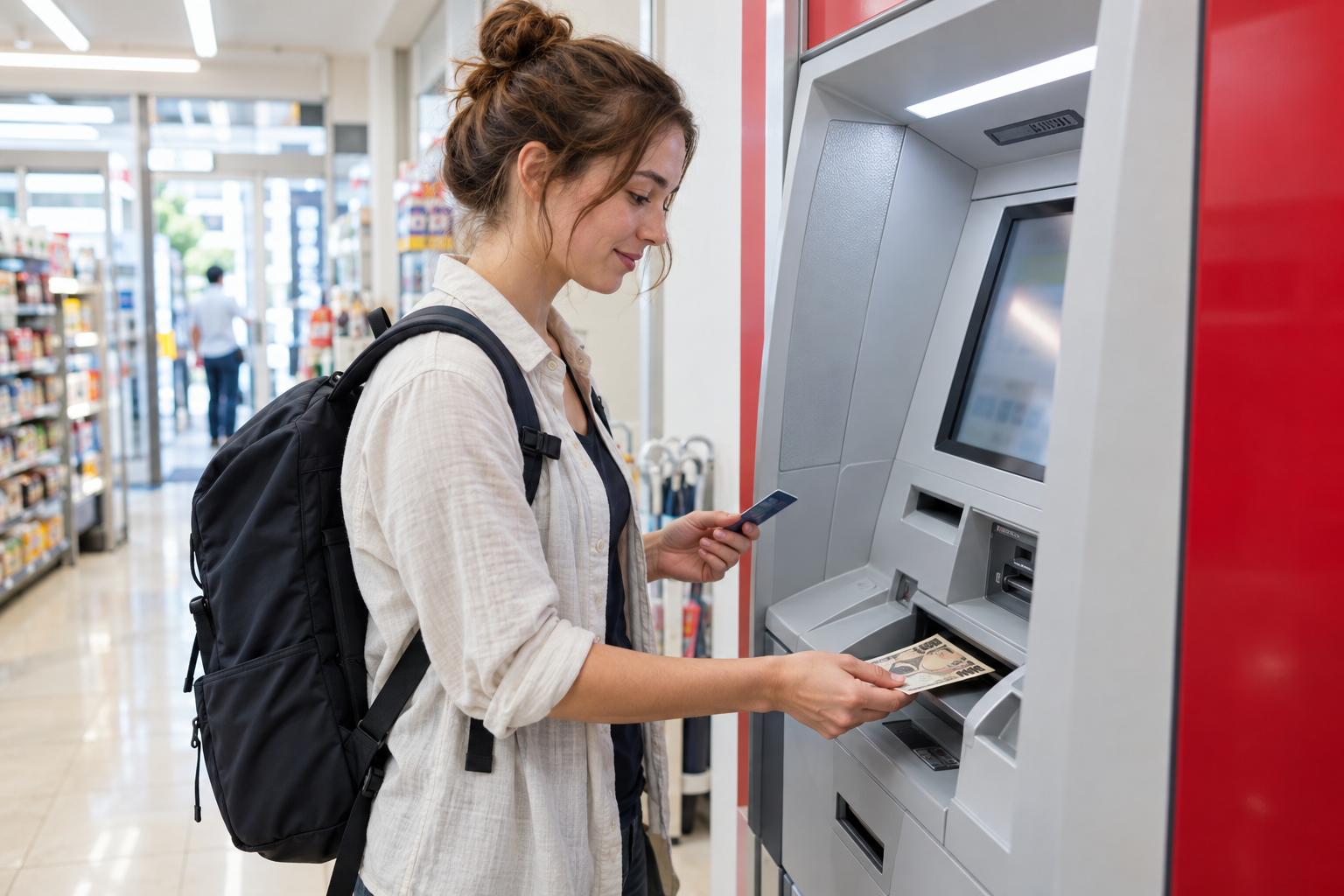
Japan is increasingly card-friendly, but cash remains useful for small restaurants, local transport, markets, temple or shrine payments and rural businesses. An ATM that serves domestic customers may not accept an overseas-issued card, so start with a clearly marked international service such as Seven Bank or Japan Post Bank. Before inserting the card, know your numeric PIN, your bank’s overseas-withdrawal settings and the different fees that can appear.
Prepare the card before departure
Confirm that the card permits overseas ATM withdrawals and check both the per-transaction and daily limits. Make sure you know the numeric PIN; a signature or mobile-app login cannot replace it at the machine. Save the issuer’s international support number and turn on transaction alerts. A debit card usually draws from your account, while a credit-card withdrawal may be treated as a cash advance with fees and interest.
Use an ATM that lists your card network
Seven Bank and Japan Post Bank are dependable starting points because their official services support multiple overseas networks and provide multilingual screens. Match the network shown on the card with the accepted marks displayed on the ATM. Acceptance can still depend on the issuer, account status and network availability, so carry a second card rather than relying on one machine or brand.
Choose withdrawal and the correct account option
After selecting a language, choose the cash-withdrawal option. The machine may ask whether the source is checking, savings or credit. Use the account type specified by your issuer; travelers with an ordinary debit card often use checking or savings depending on how the card was configured. Do not guess repeatedly if the first choice fails, because several incorrect attempts can trigger a security block.
Stay within both withdrawal limits
Seven Bank states a general ¥100,000 limit for each overseas-card withdrawal, reduced to ¥30,000 for magnetic-stripe transactions. Japan Post Bank states a ¥50,000 per-transaction limit. Your own bank may set a lower amount or daily cap. If a reasonable transaction is declined, try a smaller amount once, then contact the issuer rather than making many rapid attempts.
Read every fee before confirming
The total cost may combine an ATM operator charge, your bank’s foreign ATM fee, a currency-conversion markup and—when using credit—a cash-advance fee or interest. Japan Post Bank says certain overseas cards may incur a ¥220 ATM fee per use, while Seven Bank says the charge varies by card brand. Check the screen and your issuer’s current fee schedule; neither source can tell you the complete cost charged by your bank.
Recognize dynamic currency conversion
Some machines ask whether to complete the transaction in Japanese yen or your home currency. The home-currency option is dynamic currency conversion, using the rate displayed by the ATM provider. Choosing yen normally lets the card network and issuer perform the conversion later. Compare the shown rate and total, and check your bank’s markup; the familiar home-currency amount is not automatically the cheaper choice.
Finish securely and keep a backup
Shield the keypad, keep the card in sight and never accept help from someone who asks to handle it or observe the PIN. Take the card, cash and receipt before leaving. Store the receipt until the transaction appears correctly, then dispose of it securely. Split cards and cash between safe locations, and retain enough backup money for transport and food if a later machine or network is unavailable.
The dependable starting points
Try Seven Bank or Japan Post Bank first
Seven Bank
Commonly found in 7-Eleven stores and other locations. It accepts several major overseas card networks. The official limit for an overseas-issued card is generally ¥100,000 per withdrawal, or ¥30,000 for magnetic-stripe transactions.
Japan Post Bank
Available at post offices and other locations, including some compact ATMs in FamilyMart. It accepts listed international networks and sets a ¥50,000 limit per withdrawal for overseas-issued cards.
Your bank may impose a lower daily or transaction limit. The logo on a card does not guarantee every transaction will be approved.
Withdraw yen step by step
- Choose an ATM that explicitly accepts international cards.Check for your card network and use the machine’s language selector.
- Insert the card and choose withdrawal.For a debit card, the ATM may label the source account as savings or checking. Follow your issuer’s instructions.
- Enter the PIN privately.Shield the keypad. If you do not know the required numeric PIN, contact the issuer before travel.
- Choose an amount within both limits.The Japanese ATM and your own bank can each set a limit. A declined large amount may work when reduced.
- Review the currency and fee screen.Confirm the amount, ATM fee and conversion choice before accepting.
- Take the cash, card and receipt.Do not leave until the machine has returned everything and the transaction is complete.
Know the full cost
One withdrawal can contain several charges
Shown on the machine when applicable. Japan Post Bank says some overseas cards may incur ¥220 per use; Seven Bank says fees vary by card brand.
Your issuer may charge a fixed international withdrawal fee even when the Japanese ATM charge is small or zero.
Your card network or bank converts the yen transaction and may add a percentage markup.
A credit-card withdrawal may be treated as a cash advance, with separate fees and interest. Check before using credit.
Understand the yen or home-currency question
Some ATMs offer dynamic currency conversion (DCC): the machine converts the withdrawal into your home currency immediately. Selecting Japanese yen normally leaves conversion to your card network and issuer, while selecting your home currency accepts the ATM provider’s displayed conversion. Compare the rate and total shown rather than assuming the familiar currency is cheaper. Your issuer may still add its own fees.
If the ATM declines your card
- Try a smaller amount within the ATM’s per-transaction limit.
- Confirm the card is enabled for overseas ATM withdrawals and that its daily limit is high enough.
- Try another official international-card ATM rather than repeating the same failed transaction many times.
- Check whether the issuer blocked the transaction and use the phone number on the card or banking app.
- Keep a second card from a different network and some arrival cash in a separate place.
Never accept help from a stranger who asks to handle your card or watch you enter the PIN.
Before flying to Japan
Official ATM information
Fees, limits, accepted cards and operating hours reviewed September 23, 2026. Confirm them again at the ATM and with your card issuer.
Opening hours, prices, reservation rules and transport details can change. Confirm important details with the official operator before your visit.