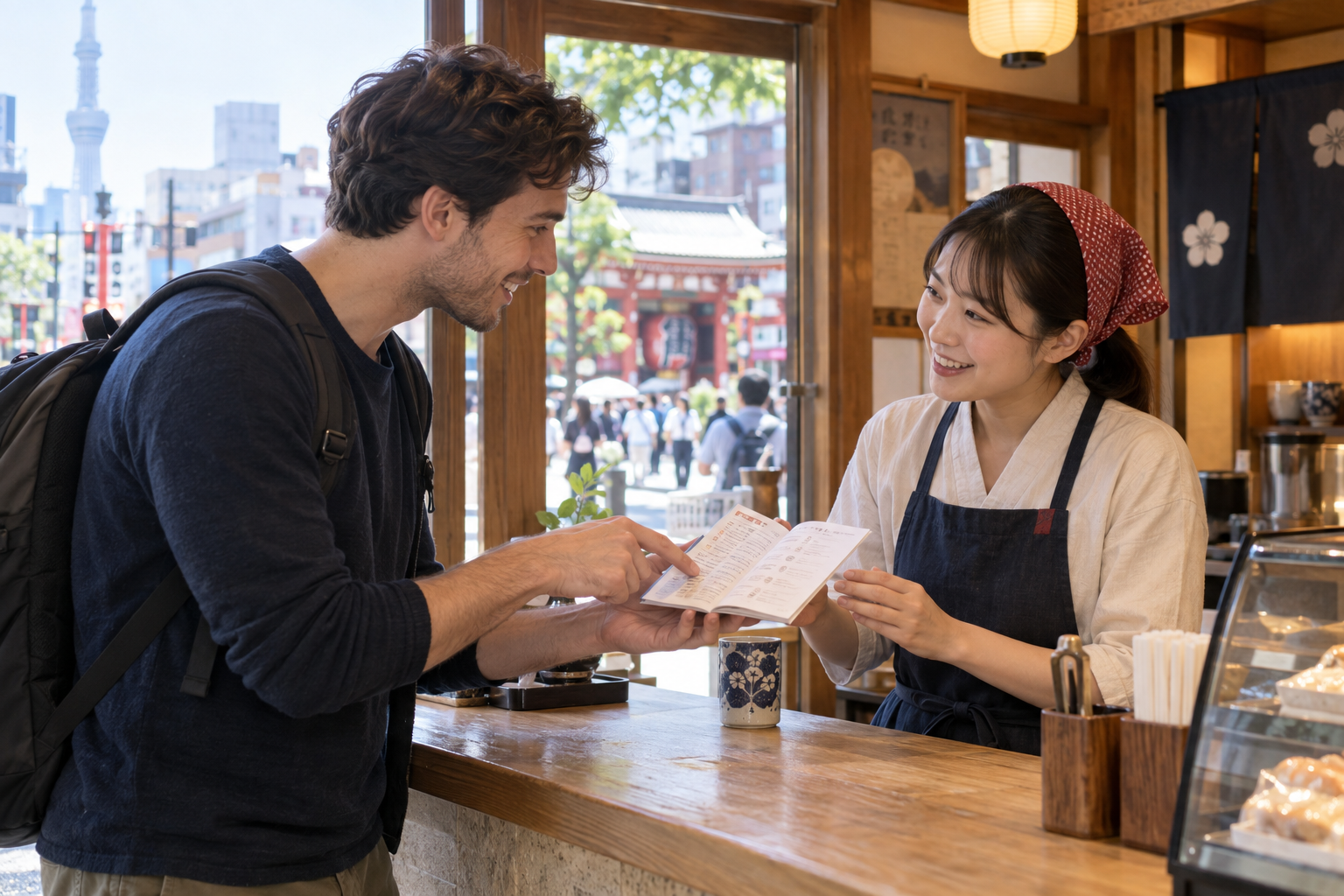
You can travel around Japan without speaking Japanese, but a few polite phrases make everyday interactions warmer and easier. These seven cover the moments travelers face most often: getting someone’s attention, saying thank you, making a request, asking where something is, checking a price, requesting an English menu and admitting that you do not understand. Say them calmly, combine them with a map or pointing gesture, and do not worry about sounding perfect.
Sumimasen: the phrase you will use most
Sumimasen (すみません) can mean “excuse me,” “sorry” or, in some situations, a grateful acknowledgment of someone’s trouble. Use it before asking a station employee a question, calling a server politely or moving past someone. It is a safer opening than shouting “hello.” Say sumimasen, pause until the person is ready, then show the destination, ticket or item connected to your question.
Arigatou gozaimasu: a polite thank-you
Arigatou gozaimasu (ありがとうございます) is the dependable polite form of “thank you” for shops, hotels, restaurants and people who help you. Arigatou alone is more casual, so the full phrase is a useful default with strangers. A small nod is enough; travelers are not expected to perform a formal bow. You may hear gozaimashita after a completed service, but gozaimasu will still communicate your thanks clearly.
Onegaishimasu: please make this request
Onegaishimasu (お願いします) is a flexible “please” used when requesting an item or service. Point to a menu item, ticket type or reservation screen and say kore o onegaishimasu—“this, please.” At a restaurant, the shorter kore o kudasai also asks for a specific item. Onegaishimasu is especially useful when the context already makes your request clear and a long sentence would create confusion.
___ wa doko desu ka?: where is ___?
Put a place before wa doko desu ka (はどこですか?) to ask where it is. Toire wa doko desu ka asks for the restroom; eki wa doko desu ka asks for the station; deguchi wa doko desu ka asks for the exit. Show the written destination on your phone when it is a proper name. Listen for directions, but also watch the person’s gesture and confirm the platform or exit number.
Kore wa ikura desu ka?: how much is this?
Kore wa ikura desu ka (これはいくらですか?) means “How much is this?” and works while pointing to an item. Prices are often clearly displayed, but this phrase helps at markets, small shops and counters. If the spoken answer is difficult, politely show a calculator screen or ask the staff member to write the number. Check whether tax is included before comparing prices.
Eigo no menyuu wa arimasu ka?: is there an English menu?
Eigo no menyuu wa arimasu ka (英語のメニューはありますか?) asks whether an English menu is available. The same pattern works with eigo no annaizu for English guidance, although showing the phrase may be easier than pronouncing every word. A translated menu can still omit allergy or preparation details, so show a clearly written dietary card when a mistake could affect your health.
Wakarimasen: I do not understand
Wakarimasen (わかりません) means “I do not understand.” It is more useful than pretending to follow an explanation. Add mou ichido onegaishimasu for “one more time, please,” or yukkuri onegaishimasu for “slowly, please.” If the conversation is still unclear, switch to a short written question, a map or a translation app rather than repeating the same English sentence more loudly.
Save this before your trip
Seven phrases at a glance
| Japanese | Say it like | Use it for |
|---|---|---|
| すみません | soo-mee-mah-sen | Excuse me, getting attention, or a light apology |
| ありがとうございます | ah-ree-gah-toh goh-zah-ee-mahs | A polite thank-you |
| お願いします | oh-neh-guy-shee-mahs | Please / this one, please |
| ___ はどこですか? | ___ wah doh-koh dess-kah | Where is ___? |
| これはいくらですか? | koh-reh wah ee-koo-rah dess-kah | How much is this? |
| 英語のメニューはありますか? | eh-ee-goh noh meh-nyoo wah ah-ree-mahs-kah | Do you have an English menu? |
| わかりません | wah-kah-ree-mah-sen | I do not understand |
Pronunciation note: the spellings above are practical approximations for English speakers. Speak slowly, keep each syllable short and show the written Japanese when accuracy matters.
Make the phrases more useful
Simple words you can insert
For example, トイレはどこですか? means “Where is the restroom?” Pointing to a map, ticket or destination name while asking often works better than trying to build a long sentence.
Three helpful follow-up phrases
もう一度お願いします
Mou ichido onegaishimasu — One more time, please.
ゆっくりお願いします
Yukkuri onegaishimasu — Slowly, please.
これをください
Kore o kudasai — This one, please. Useful when ordering or shopping while pointing.
Onegaishimasu is a flexible polite request. Kudasai works naturally when asking for a specific item. You do not need to master the grammar to use either courteously.
When words are not enough
Use a calm three-step fallback
- Say “sumimasen.” Get the person’s attention without raising your voice.
- Show the destination or question. Use a map, booking screen or translated sentence with the key details visible.
- Confirm the answer. Repeat the platform number, time or price and use your fingers or calculator if needed.
Machine translation is useful, but keep sentences short and avoid slang. For medical, legal or emergency information, use qualified interpretation or official assistance rather than relying only on a phrase list.
Official language resources
Language guidance reviewed September 23, 2026.
Opening hours, prices, reservation rules and transport details can change. Confirm important details with the official operator before your visit.