
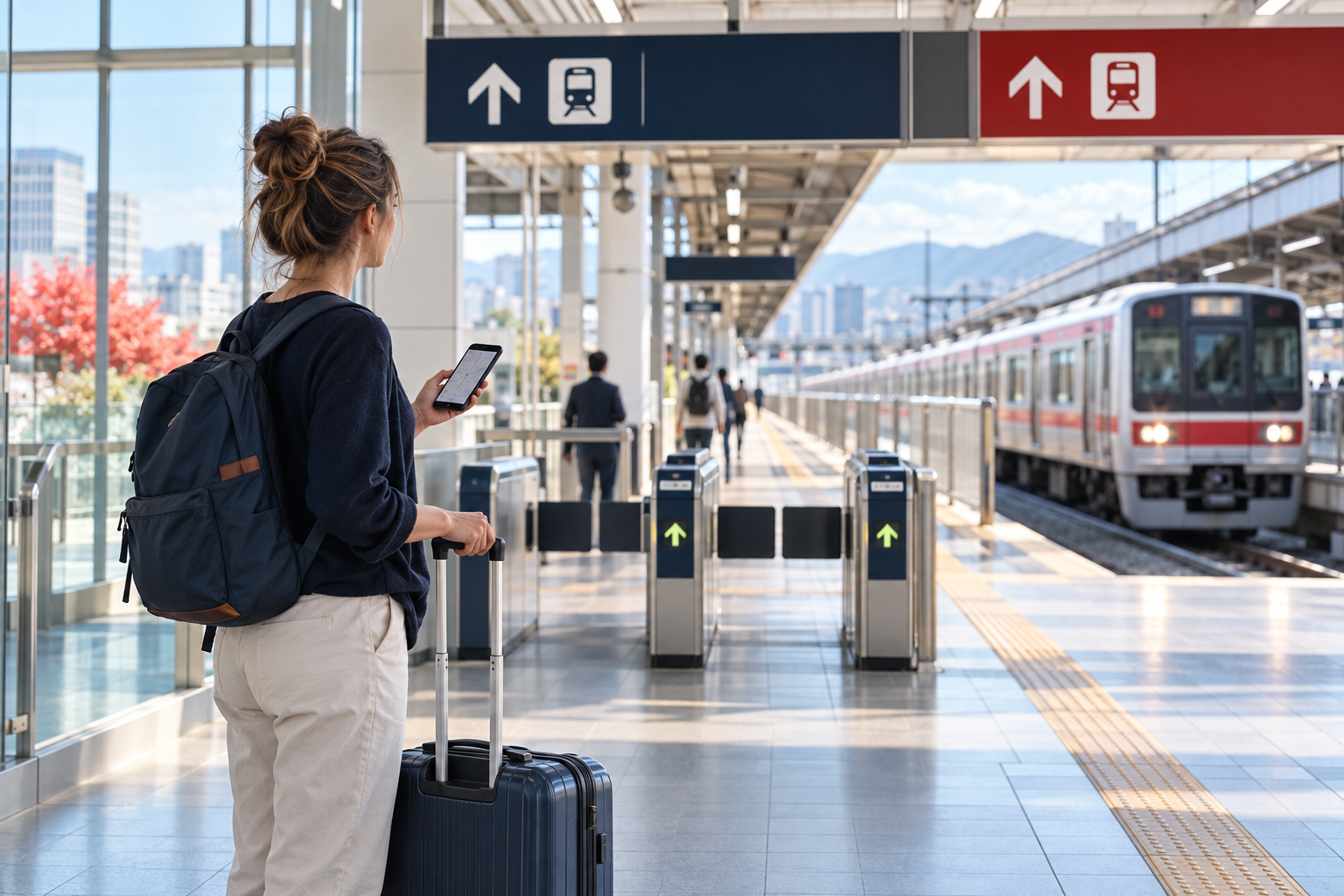
Japan’s trains become much easier when you separate four decisions: which operator and line you need, which train type stops at your station, what fare or supplement is required, and which platform serves the correct direction. An IC card simplifies many local journeys, but it does not turn every railway into one system or replace every limited-express and Shinkansen ticket. Use this guide as a repeatable station routine and confirm current details with the operator.
Plan by station, operator and direction
Start with the exact station names, not only the neighborhood or line color. Large stations can contain JR, subway and private-railway areas with separate gates. Check the operator, line name, direction or terminal station and platform before entering. A route app is useful, but compare its operator and train name with the signs. If two stations have similar names, confirm the Japanese characters or map position before paying.
Check whether the train stops at your station
Local, rapid, express and limited-express services can share a platform but stop at different stations. The fastest train is useful only if your destination is one of its stops. Read the departure display and stopping pattern before boarding. Service labels differ among operators, so do not assume that “express” means the same thing everywhere. When uncertain, show the destination to staff and ask which departure to use.
Know whether you need one fare or a supplement
Ordinary local travel needs a basic fare, paid with a valid ticket, IC card or pass. Shinkansen and many limited-express journeys also require an express ticket; reserved seats require the appropriate reservation. JR East explains that a Shinkansen journey normally combines a basic fare with a super limited-express ticket. Check whether an online reservation includes both parts and keep every required ticket until you exit.
Use the same payment medium from entry to exit
Tap the same physical IC card, phone or contactless card at both ends of an eligible trip. Mixing a phone at entry with a plastic card at exit leaves the journey incomplete. If you use a paper ticket, insert it as directed and collect it when the gate returns it. A low balance or route outside an IC service area may require fare adjustment or staff help; do not force the gate or follow another passenger through.
Treat transfers as part of the route
A transfer may stay inside the paid area, use a designated transfer gate or require you to exit and re-enter. Follow the specific line and operator signs rather than relying on the closest exit. Tokyo Metro, for example, identifies special transfer procedures at some stations. Allow extra time at major hubs, because the walk between platforms can be long even when a route app displays a short connection.
Reserve seats and baggage space when required
Check whether the train is all-reserved, whether your ticket is for a reserved or non-reserved car and which car number to board. On the Tokaido, Sanyo, Kyushu and Nishi Kyushu Shinkansen, baggage with combined dimensions over 160 cm and up to 250 cm requires a seat with an oversized-baggage area. Measure before traveling, reserve the correct space and never assume the area behind the last row is open storage.
Board considerately and protect the final connection
Queue at the platform markings, let passengers leave first and keep luggage out of doors and aisles. Follow quiet-carriage norms, remove a bulky backpack in a crowded train and use priority space considerately. Check the last practical departure rather than assuming city trains run all night. If disruption affects a reserved journey, use the operator’s official service information and ask staff before buying a duplicate ticket.
Use the same sequence every time
A repeatable station routine
Confirm the exact departure and destination stations.
Find the correct JR, subway or private-railway entrance.
Check local, rapid, express or limited express and its stops.
Use the required IC card, paper ticket, pass or supplement.
Match the direction, departure time and car position.
Which ticket do you need?
| Journey | Typical requirement | Confirm before boarding |
|---|---|---|
| Local or rapid train | Basic fare by IC card, ticket or valid pass | The service stops at your station and remains in a supported IC area |
| Limited express | Basic fare plus limited-express ticket in many cases | Reserved or non-reserved car and whether the service is all-reserved |
| Shinkansen | Basic fare plus Shinkansen express ticket, or an eligible combined product | Train, date, departure, car, seat and baggage reservation |
| Rail pass journey | Valid pass plus any required seat reservation | Operator, route, train and seat type are covered |
| Cross-region IC journey | Buy the appropriate ticket in advance | Major IC cards generally cannot complete continuous travel across separate service areas |
Ticket products and coverage vary. Check the operator’s official booking page for the exact train rather than treating this table as a fare quote.
The high-save checklist
7 train mistakes first-time visitors should avoid
Entering the gate before checking the operator and platform direction.
Boarding a rapid or express train that skips the destination.
Assuming an IC card covers the Shinkansen or limited-express supplement.
Tapping in with one card or device and trying to exit with another.
Taking the wrong exit at a large station and adding a long walk.
Bringing oversized Shinkansen baggage without the required reservation.
Ignoring the last train or leaving too little time for a major transfer.
Train terms worth recognizing
- Local
- Usually stops at every station on its route.
- Rapid / Express
- Skips selected stations; the pattern depends on the operator.
- Limited Express
- A faster named service that commonly requires an additional ticket.
- Reserved seat
- A specific car and seat assigned to your ticket.
- Non-reserved seat
- Use only a designated non-reserved car when the train offers one.
- Fare adjustment
- A machine or staffed process for resolving an insufficient or incorrect fare.
Official train resources
Guidance reviewed September 23, 2026. Train operations, ticket products and rules can change.
Opening hours, prices, reservation rules and transport details can change. Confirm important details with the official operator before your visit.