
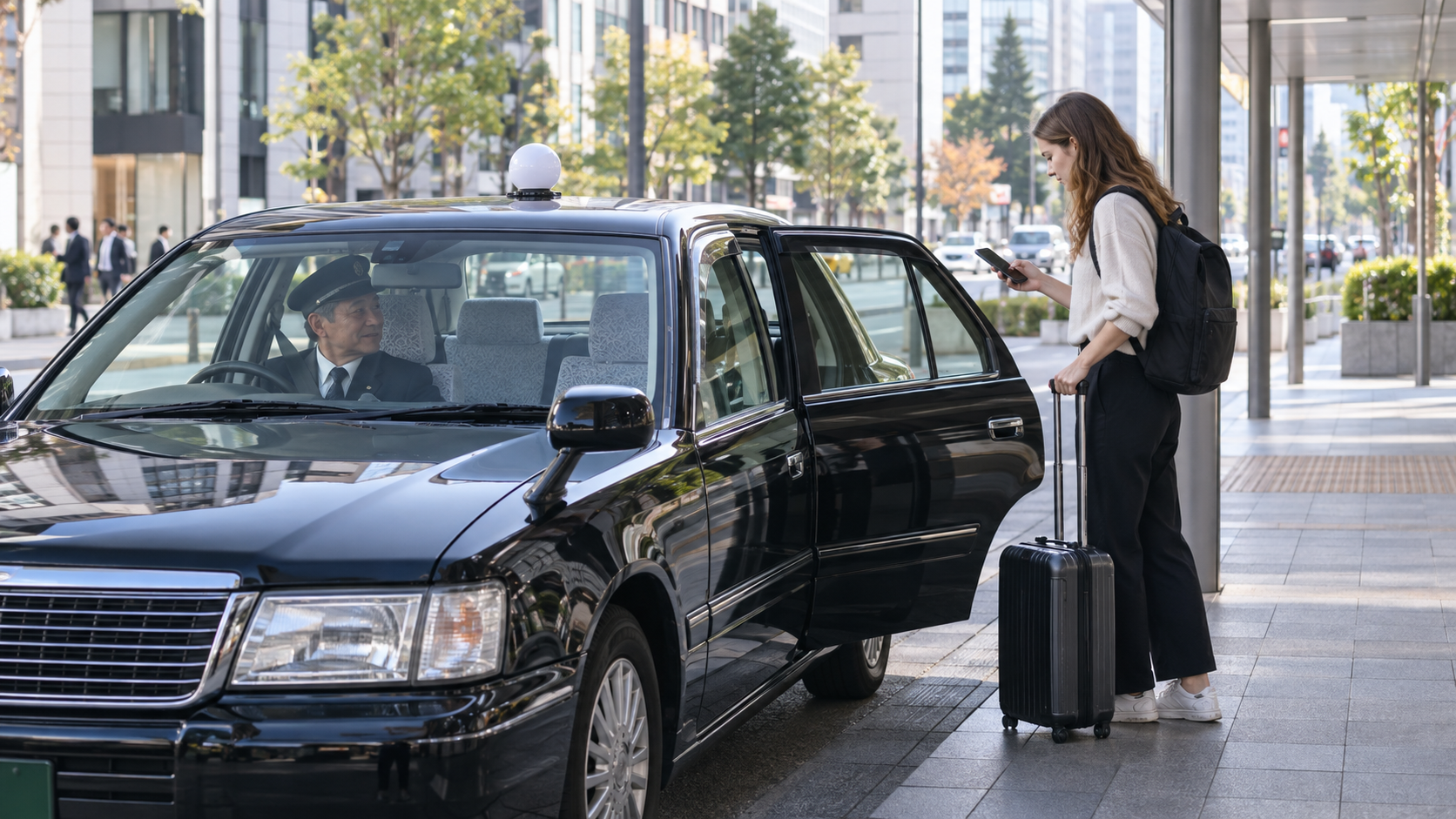
A taxi in Japan can simplify a short trip with luggage, a late-night return or a journey between places that are awkward by train. The basic ride is straightforward: use a legal taxi stand, hail an available cab where stopping is permitted or request one through a supported app; show the exact destination; let the driver operate an automatic rear door; follow the meter; and pay by an accepted method. The details that surprise visitors are the extra charges and the fact that payment options vary by vehicle, city and app.
Choose a taxi when it solves the difficult part
Taxis are usually more expensive than public transport, but they can be practical for a group sharing the fare, travelers with heavy luggage, mobility needs, rain, a short local connection or travel after the last convenient train. Compare the complete door-to-door journey rather than the driving time alone. For long intercity travel, rail or bus will usually be more economical; for airports, compare fixed-fare taxi schemes and official transfers before relying on a standard metered ride.
Use a taxi stand, street hail or supported app
Major stations, airports, hotels and busy districts commonly have marked taxi stands. Queue at the stand and take the first available car as directed. On an ordinary street, hail only where the vehicle can stop legally and safely; a vacant-light indication varies by taxi and may be in Japanese. A dispatch app can reduce language friction and preserve the pickup and destination, but service areas, app charges, payment flow and available vehicles differ. Hotel or restaurant staff can also call a taxi, sometimes with an ordering charge.
Prepare the exact destination before boarding
Save the destination name, full Japanese address, map pin and telephone number before the ride. A hotel entrance, station exit or building name is more useful than a broad neighborhood. Show the details on your phone and confirm the map pin when using an app. If the property has more than one entrance, choose the correct one. Keeping the address available offline also protects the trip when mobile reception or an app fails.
Let the driver control the rear door
Many Japanese taxis have a rear left passenger door that the driver opens and closes automatically. Stand clear, wait for it to open and do not pull or push it unless the driver indicates otherwise. Load large bags as directed, use the seat belt and keep belongings away from the door. Before moving off, check that the destination shown or understood is correct. A simple map screen and polite greeting are enough even when you do not share a language.
Read the meter and separate the extra charges
Taxi fares are regulated locally rather than set at one national price. The meter normally combines distance with time spent moving slowly or waiting. The displayed or final amount can also include a late-night or early-morning premium, an ordering or app charge, expressway tolls and other disclosed fees. In Tokyo’s 23 wards, Musashino and Mitaka, the association currently lists a 20 percent late-night and early-morning premium from 10 p.m. to 5 a.m.; other areas can differ. Check the local operator or association before travel.
Confirm how you will pay before the ride
Cash remains a useful backup, while many taxis accept cards, transit IC cards, QR payments or payment through a dispatch app. Acceptance is not identical across every vehicle. Check the window or door stickers, app payment screen or ask the driver before departure if a specific method matters. An app-booked ride may be paid automatically in the app or may require in-car payment, depending on the service and selection. Keep a small amount of yen and a second payment method.
Pay the shown fare and keep the receipt
At the destination, wait until the taxi stops and the final amount is confirmed. Pay using the method agreed for that ride and collect the receipt, especially when carrying important belongings. Tipping is not customary; pay the displayed fare unless a clearly explained charge applies. Check the seat and footwell before leaving, then let the driver operate the automatic door. A receipt can help identify the taxi company if you later discover that an item was left behind.
Choose the easiest pickup
Three reliable ways to get a taxi
Best at stations, airports and major hotels. Join the marked queue and take the first available taxi.
Useful on a safe legal stopping point. Look for an available taxi and raise your hand clearly.
Best when the pickup or destination is hard to explain. Check dispatch fees and the payment method.
A repeatable ride routine
From pickup to drop-off in five steps
- Prepare: save the Japanese address, map pin, building name and phone number.
- Board: wait for the rear door; the driver often opens and closes it automatically.
- Confirm: show the destination and check the app or map pin before departure.
- Ride: follow the meter and expect disclosed extras such as tolls or late-night charges.
- Finish: pay by an accepted method, take the receipt and check the seat for belongings.
Taxi fare and payment decoder
| Item | What it means | What to check |
|---|---|---|
| Meter fare | Local starting fare plus distance, with time added in slow traffic or while waiting | Rates differ by city and operating area |
| Late-night premium | A percentage increase during the locally defined overnight period | Tokyo’s listed period is 10 p.m.–5 a.m.; do not assume this nationwide |
| Ordering / app charge | A separate fee may apply when a taxi is dispatched to you | Review the app or taxi-company fee before requesting |
| Expressway toll | Tolls can be added to the taxi fare when the route uses a paid road | Ask whether the suggested route includes a toll road |
| Cashless payment | Card, IC, QR or in-app payment may be available | Confirm the exact method on the vehicle or app before riding |
A fare estimate is useful for planning, but traffic, waiting time, route choice and disclosed fees can change the final amount.
Save this before leaving Wi-Fi
What to put on your destination card
- Property or place name in Japanese and English
- Full Japanese street address
- Map pin for the correct entrance
- Telephone number
- Nearby station exit or landmark, when useful
Useful phrase: “Koko made onegai shimasu” means “Please take me here.” Show the saved address as you say it.
Five taxi mistakes to avoid
Giving only a neighborhood name instead of an exact entrance or address.
Pulling an automatic rear door while the driver is operating it.
Assuming every vehicle accepts the same card, IC card or QR payment.
Ignoring late-night, dispatch, app or expressway charges in the estimate.
Leaving without a receipt or checking the seat for a phone, wallet or bag.
Official taxi resources
Guidance reviewed September 28, 2026. Fares, service areas, payment methods and app charges can change; confirm current details before travel.
Opening hours, prices, reservation rules and transport details can change. Confirm important details with the official operator before your visit.