
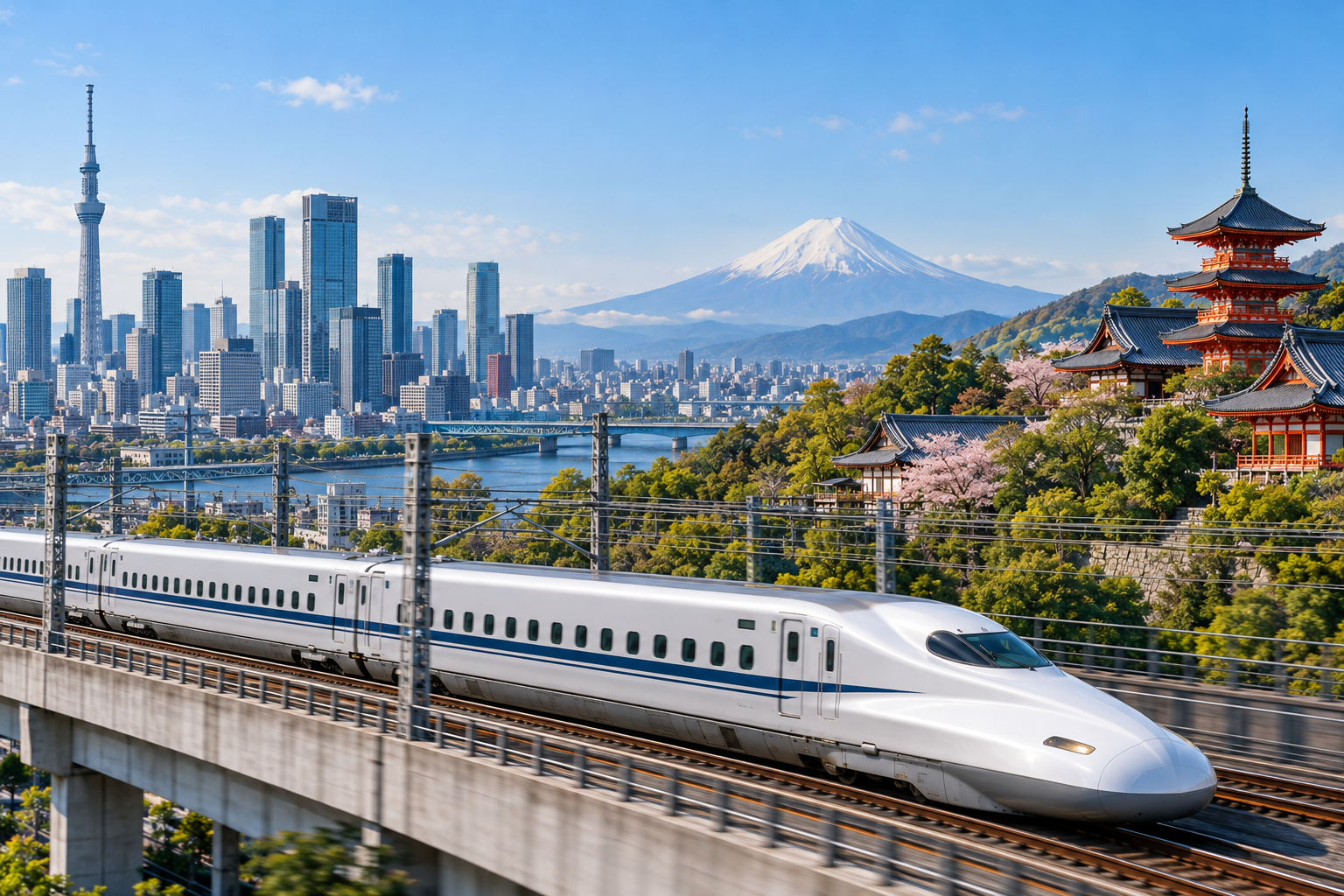
For most first-time visitors, the Tokaido Shinkansen is the simplest way from central Tokyo to central Kyoto. A night bus can reduce the cash fare and replace a hotel night, while flying only becomes competitive when an airport fits the wider itinerary. The right choice therefore depends on more than the advertised journey time. Compare the trip from your Tokyo hotel door to your Kyoto hotel door, include baggage and sleep, and protect the first activity after arrival. This guide uses that complete journey—not a headline price—to help you choose.
Start with the default: the Shinkansen
The Tokaido Shinkansen links Tokyo or Shinagawa directly with Kyoto Station, avoiding an airport transfer and a bus terminal arrival. Kyoto City Tourism lists approximately 130 minutes by Nozomi and about 170 minutes by Hikari from Tokyo Station. Add the trip from your hotel to Tokyo or Shinagawa, station navigation and the journey from Kyoto Station to the accommodation. Even after those additions, rail is usually the strongest city-center-to-city-center option.
Choose Nozomi, Hikari or Kodama deliberately
Nozomi makes fewer stops and is normally the fastest choice. Hikari takes longer but may fit travelers using a pass whose conditions cover it. Kodama stops most frequently and usually sacrifices too much time for a full Tokyo–Kyoto journey unless a specific fare or intermediate stop makes it useful. Check the exact train, date, seat type and product conditions rather than assuming every Tokaido Shinkansen ticket works the same way.
Use a night bus only when the sleep trade-off works
Overnight buses can leave Tokyo late and reach Kyoto early, potentially saving both a daytime travel block and one hotel night. That saving is real only if the boarding point, seat, luggage allowance and arrival time work for you. A poor night of sleep can remove the value by weakening the first Kyoto day. Confirm the exact Tokyo stop, Kyoto drop-off, boarding deadline, rest stops, cancellation policy and whether the seat layout provides enough privacy and recline.
Treat flying as an airport-to-airport detour
Kyoto has no commercial airport. A flight from Tokyo normally means traveling to Haneda or Narita, completing airline formalities, flying to an Osaka-area airport, collecting baggage and transferring onward to Kyoto. Osaka Itami has a direct airport bus to Kyoto Station, but the ground segments and buffers often make the complete journey slower and more complicated than rail. Flying is worth comparing when it connects with another flight or when a fare and airport location solve a wider itinerary problem.
Choose Tokyo or Shinagawa by your hotel location
Tokyo Station works naturally from Marunouchi, Ginza, Ueno and many eastern or central areas. Shinagawa can reduce backtracking from Haneda, southern Tokyo and some hotels on the Yamanote or Keikyu corridors. Do not choose the station only because one departure appears a few minutes earlier. Compare the hotel-to-platform trip, elevators, luggage and the platform shown on the final reservation.
Measure luggage before choosing a seat
On the Tokaido Shinkansen, baggage whose three dimensions total more than 160 cm and up to 250 cm requires a reservation for an appropriate oversized-baggage seat or space. Smaller luggage still needs to fit safely in the rack, footwell or available storage. If a large suitcase makes the transfer difficult, forward it to Kyoto and carry medicine, documents, chargers and one night of essentials separately.
Protect the Kyoto arrival
Kyoto Station is a major gateway, not the final destination for every visitor. A hotel near Gion, Kawaramachi, Arashiyama or northern Kyoto can require another train, subway, bus or taxi. Late arrivals have fewer onward options, while a very early bus arrival may come before luggage storage or check-in. Save the hotel address offline, confirm its luggage policy and avoid attaching a non-refundable timed attraction to the first hour after arrival.
The short answer
Which option fits your trip?
Direct city-center travel, frequent departures and a usable arrival time make rail the default choice.
Choose it when the lower fare and saved hotel night matter more than sleep quality and daytime energy.
Compare it when you are already near an airport or connecting from another flight—not merely because the flight time looks short.
Door-to-door comparison
Compare the complete journey
| Option | Typical transport pattern | Best advantage | Main cost you may overlook |
|---|---|---|---|
| Shinkansen | Hotel → Tokyo/Shinagawa → Kyoto Station → hotel | Fast, frequent and central | Station access, seat choice and final Kyoto transfer |
| Night bus | Hotel → Tokyo bus stop → overnight ride → Kyoto stop → luggage storage | Lower cash fare and possible hotel-night saving | Sleep loss, strict boarding point and early arrival |
| Flight | Hotel → Tokyo airport → Osaka-area airport → Kyoto | Useful with a connecting flight | Airport access, check-in buffer, baggage and Kyoto transfer |
Do not compare only the time printed beside the vehicle. Start the clock at your Tokyo hotel and stop it at your Kyoto accommodation.
Train decoder
Nozomi, Hikari or Kodama?
Fastest and most frequent for this corridor. Check the exact ticket or rail-pass conditions before assuming it is included.
A slower direct alternative that can suit some pass users. Verify the stops and departure rather than choosing by name alone.
Stops most frequently. It is rarely the best full-route choice unless a specific product or intermediate destination changes the calculation.
Before reserving
Measure the bag, then choose the seat
- Add length, width and height. Baggage over 160 cm in total dimensions and up to 250 cm needs an eligible reserved baggage space on the Tokaido Shinkansen.
- Do not claim the space behind a last-row seat without the matching reservation. It belongs to passengers who reserved it.
- Keep valuables and one night of essentials with you. Forwarding the main suitcase can make the hotel-to-station journey easier.
- Check bus and airline limits separately. A bag accepted on the train may create a charge or restriction elsewhere.
Protect your first Kyoto hours
Plan what happens after Kyoto Station
Rail is especially simple. Confirm which side of the station and whether the hotel stores luggage before check-in.
Add the subway, bus, taxi or a private-rail connection. Peak traffic can make the final bus slower than expected.
Kyoto Station is not the finish. Compare the onward JR route with your exact hotel location and luggage.
Check the drop-off point, opening time of luggage storage and where you can rest before attractions open.
Seven mistakes to avoid
- Comparing a two-hour train ride with a one-hour flight while ignoring both airports.
- Buying the cheapest bus before checking its Tokyo boarding point and Kyoto drop-off.
- Assuming an IC-card balance alone is a Shinkansen ticket.
- Bringing oversized baggage without reserving the correct space.
- Choosing Tokyo Station when Shinagawa is much easier from the hotel—or the reverse.
- Booking the last practical train without checking the onward trip to the Kyoto hotel.
- Scheduling a timed Kyoto attraction immediately after arrival.
Official planning sources
Information reviewed November 2, 2026. Timetables, fares, ticket conditions, baggage rules and bus operations can change; confirm the exact journey before purchase.
Opening hours, prices, reservation rules and transport details can change. Confirm important details with the official operator before your visit.