
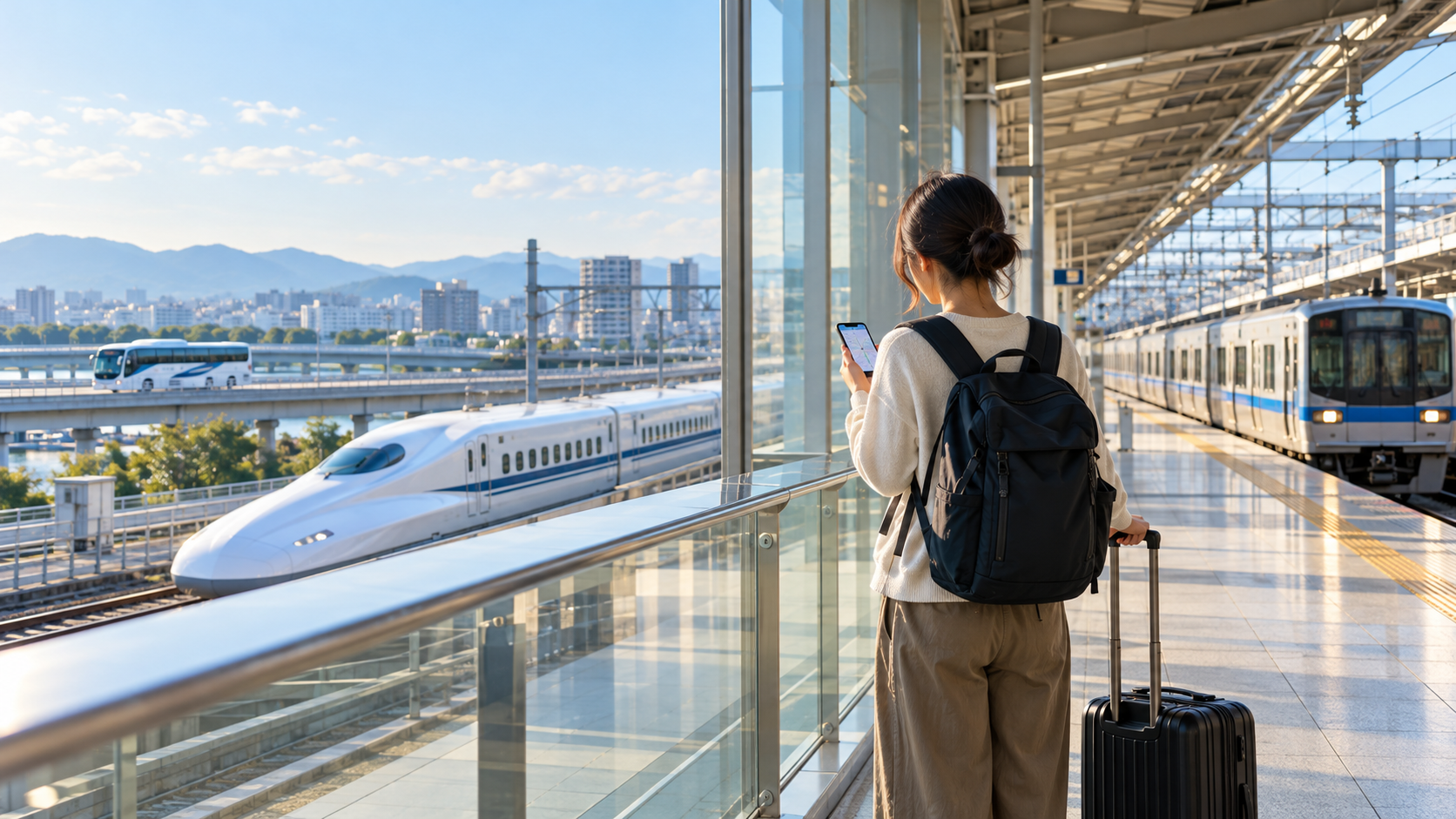
You do not need a nationwide JR Pass to travel comfortably around Japan. Many first trips work well with an IC card for local journeys, individual tickets for the Shinkansen and one carefully chosen regional pass—if the route makes that pass worthwhile. Other trips are faster or less expensive when a highway bus, domestic flight, ferry or rental car replaces one long rail segment. The key is to price the itinerary you will actually take instead of choosing a pass first and forcing the trip to fit it. This guide gives you a repeatable way to compare the options without relying on a single ticket product.
Use an IC card for ordinary city travel
A rechargeable IC card such as Suica, PASMO or another interoperable regional card makes local trains, subways and many buses easier: tap in, tap out and let the system deduct the fare. It is a payment tool rather than a universal discount pass, and it does not replace every limited-express or Shinkansen ticket. Keep enough balance for local journeys, check whether your rural bus or station accepts the card and retain a physical or mobile backup when your phone battery matters.
Buy individual tickets when the route is simple
Individual tickets are often the cleanest choice for a Tokyo–Kyoto–Osaka trip, a single Shinkansen ride or an itinerary with only one or two expensive rail days. Long-distance rail fares can include a basic-fare portion plus a limited-express or reserved-seat portion, while some online products combine them. Use the official booking service for the line you need, confirm exactly what the product covers and keep local transport separate unless the conditions explicitly include it.
Check a regional pass before a nationwide pass
A regional pass can be useful when several costly journeys fall inside one operator’s valid area and fit the pass period. Examples include focused travel in Tohoku, Nagano–Niigata, Kansai, Hokkaido or Kyushu, but coverage, eligibility, excluded lines and seat-reservation rules differ. Mark every paid rail segment on your itinerary, total comparable individual fares, then check the current official area map and conditions. A pass that saves money but creates detours or rushed day trips is not good value.
Use highway buses when time and sleep trade-offs make sense
Highway buses connect major cities and many places with limited rail access. Day buses can be practical for destinations such as the Fuji Five Lakes, while overnight services may replace both a hotel night and a long daytime journey. Compare the arrival location, luggage allowance, seat type, rest stops and cancellation rules—not only the headline fare. A night bus is a poor bargain if lost sleep removes the next day from your trip.
Compare a domestic flight for very long jumps
Flying can make sense between regions such as Tokyo and Hokkaido, Kyushu or Okinawa, especially when your itinerary does not include interesting stops between them. Compare the complete door-to-door journey: travel to the airport, check-in buffer, baggage fees, arrival-airport access and the value of your time. Rail remains attractive for city-center to city-center travel, while a low base airfare can become less competitive after extras.
Use ferries and rental cars for routes rail does not solve well
Ferries are part of the journey to many islands and can also provide overnight links between distant ports. A rental car becomes useful for scattered rural sights, mountain areas and coastlines with infrequent buses. Before driving, confirm that the driver has the legally required licence or permit for Japan, budget for tolls, fuel and parking, and check winter-road requirements. Do not rent a car merely to move between Tokyo, Kyoto and Osaka, where rail is usually simpler.
Treat luggage as part of the transport plan
The fastest route is not always the easiest route with large bags. Reserve the correct Shinkansen seat when oversized-baggage rules apply, check bus and airline allowances and avoid tight station transfers with heavy luggage. Forwarding a suitcase between hotels can make a regional pass, flight or one-night rural detour much easier. Pack medicine, documents, chargers and one change of clothes in a small bag because same-day delivery should never be assumed.
Start with your actual route
Which Japan transport ticket do you need?
Use stored value for routine rides. Compare a city day pass only when you have enough eligible trips on the same day.
Reserve the train you want and keep the rest of the itinerary flexible. This is often the simplest fit for the classic Tokyo–Kyoto–Osaka route.
Total the covered journeys, then verify the operator, validity period, eligible trains and any excluded sections on the official site.
Use door-to-door time and the final price after baggage and airport access. The lowest headline fare is not always the best journey.
Do the arithmetic before buying: list each intercity segment, find its current individual fare, add required seat charges and compare that total with every pass you are considering.
Quick comparison
Match each option to the job it does best
| Option | Best for | Check before buying | Main limitation |
|---|---|---|---|
| IC card | Local trains, subways and many buses | Acceptance and remaining balance | Usually convenience, not a fare discount |
| Individual rail ticket | One or two intercity journeys | Basic fare, express fare and seat type | Each journey is priced separately |
| Regional rail pass | Concentrated travel inside one area | Area map, validity and eligible trains | Operator and route boundaries |
| Nationwide JR Pass | Multiple expensive JR journeys across regions | Eligibility, current price and exact coverage | May cost more than a simple itinerary |
| Highway bus | Budget routes, night travel and rail gaps | Arrival point, luggage and seat conditions | Traffic and reduced sleep |
| Domestic flight | Long jumps and islands | Airport access, baggage and check-in time | Extra transfers at both ends |
| Ferry | Islands and selected overnight routes | Weather, port access and cabin type | Infrequent schedules |
| Rental car | Rural areas with scattered stops | Licence, tolls, fuel, parking and winter rules | Unnecessary stress in major cities |
Five-minute pass check
Calculate value without building a spreadsheet maze
- Separate local and intercity travel. Do not inflate a rail-pass comparison with subway or private-rail trips the pass does not cover.
- Write every expensive segment. Include airport access, Shinkansen, limited expresses and any reserved seats you genuinely plan to use.
- Price the same level of service. Compare reserved with reserved and ordinary with ordinary; do not mix products simply to make one side look cheaper.
- Check the map and calendar. Confirm operator boundaries, consecutive-day rules, excluded trains and whether the pass is available to your visitor status.
- Value flexibility. A small theoretical saving may not justify compressing all long trips into the pass window.
Common first-trip patterns
What usually deserves comparison
Price the Tokyo–Kyoto or Tokyo–Shin-Osaka journey directly. Kyoto–Osaka is a short regional trip with several rail operators.
A regional pass may become relevant when multiple Shinkansen journeys fall inside its map and validity period.
Compare the experience and door-to-door time. Flying may save hours, while rail can suit travelers who want stops along the way.
Check the final bus of the day, seasonal service and parking before deciding. A car is valuable only when it solves a real access problem.
A safe booking order
Confirm cities, dates and overnight stops before buying a pass.
Reserve peak-day trains, flights, buses and ferries whose sell-out would damage the itinerary.
Set up an IC card or prepare small cash for local services that do not accept it.
Keep reservation numbers, QR tickets and pickup instructions available without mobile data.
Six mistakes that make transport harder
- Buying a pass before the itinerary. The pass then dictates unnecessary travel.
- Assuming every railway is JR. Subways and private operators may require separate fares.
- Treating an IC card as a universal ticket. Some express, Shinkansen and rural journeys need another ticket or reservation.
- Comparing headline prices only. Add baggage, airport access, seat fees and the value of a hotel night.
- Scheduling the last connection. Weather and delays can turn a perfect plan into an expensive taxi or missed stay.
- Carrying every suitcase everywhere. Forwarding or station storage can make the better route much easier.
Official sources
Information reviewed October 14, 2026. Fares, pass products, eligible trains, reservation windows and operating schedules can change. Recheck the exact journey with the relevant operator before purchase.
Opening hours, prices, reservation rules and transport details can change. Confirm important details with the official operator before your visit.